“Heavy” is often treated as a feeling. An instinct. Something you either understand or you don’t. At Fate of the Damn’d, we’ve found that heaviness is neither mysterious nor accidental. It is built. Measured. Repeated. Optimized.
When approached correctly, heavy music produces consistent, predictable results.
1. Riff Density and Weight
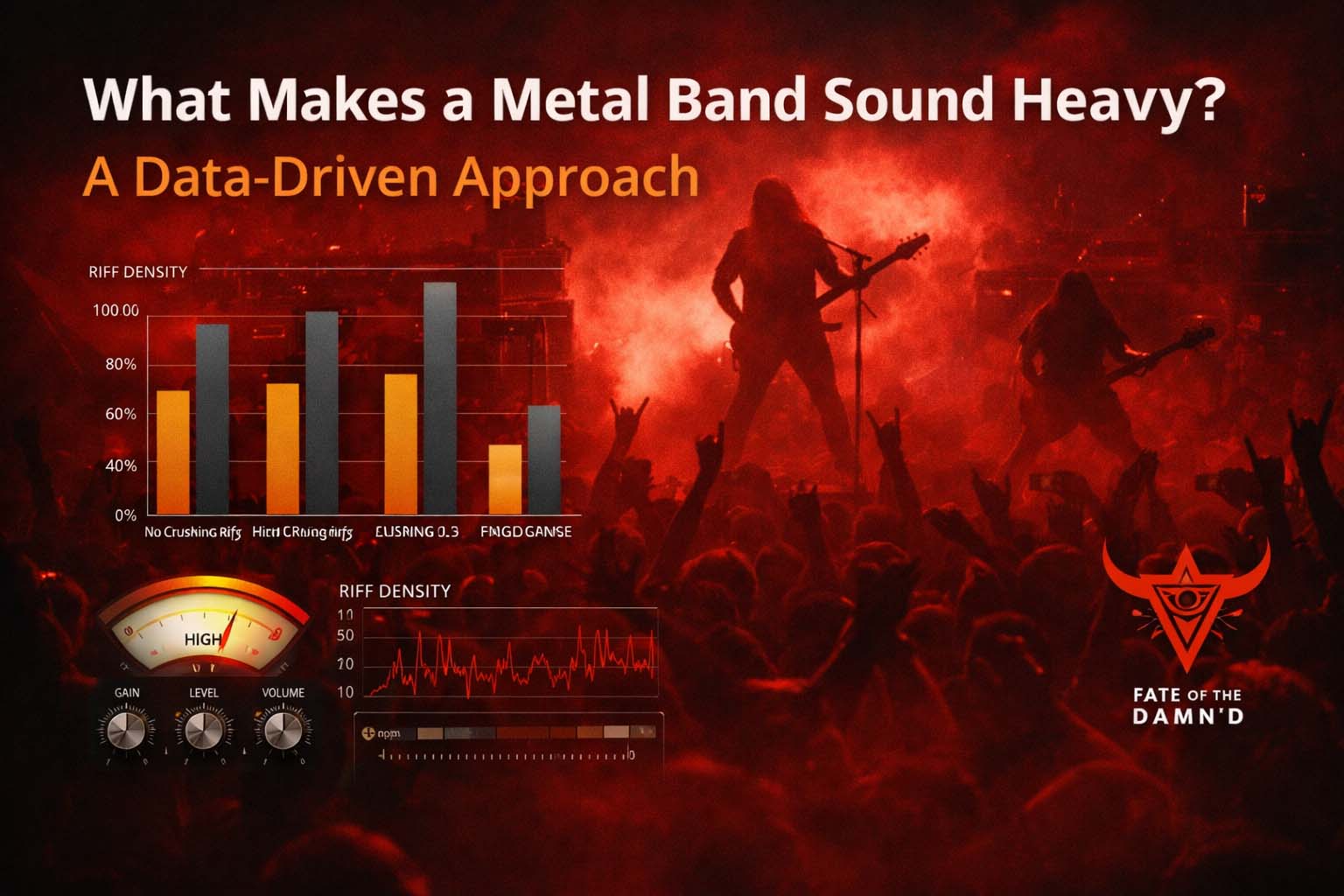
At its core, heaviness begins with riffs — not just how distorted they are, but how they occupy space. Effective riffs create pressure. They repeat long enough to establish control, then shift just enough to maintain attention.
This is not chaos. It is managed force.
A riff that hits hard once is memorable. A riff that hits hard repeatedly becomes directive.
2. Tempo as Behavioral Control
Contrary to popular belief, faster does not always mean heavier. Tempo dictates how bodies move, how heads nod, and how long attention is sustained.
Mid-tempo grooves tend to outperform extremes. They allow the listener to synchronize rather than react. Over time, this synchronization produces comfort. Comfort produces trust.
Trust is heavy.
3. Groove and Collective Alignment
Groove is where individual movement becomes collective response. When rhythm locks in, separation dissolves. People stop listening independently and start responding together.
This is not accidental. Groove is the mechanism through which a room becomes a unit.
In high-performing environments, alignment matters more than virtuosity.
4. Tone Consistency Across Systems
Heaviness degrades when tone becomes inconsistent. Guitar, bass, drums, and vocals must reinforce the same message, not compete for dominance.
Consistency builds reliability. Reliability builds expectation. Expectation builds anticipation.
Anticipation is where pressure lives.
5. Repetition Without Relief
True heaviness resists release. It does not rush to resolve tension. It holds it. Extends it. Allows it to settle in.
Repetition conditions the listener to accept the weight rather than escape it. Over time, resistance decreases.
This is often described as “groove,” “vibe,” or “feel.” Internally, we call it effectiveness.
6. Environment Matters
Volume, lighting, visual reinforcement — these are not accessories. They are amplifiers. Heaviness increases when sound is supported by atmosphere and expectation.
The brain responds more predictably when multiple inputs deliver the same message.
Sound alone is powerful. Sound plus environment is convincing.
7. Measurement and Iteration
The heaviest bands refine their approach over time. They observe crowd response. They note engagement levels. They adjust.
Heaviness that cannot be repeated is noise. Heaviness that can be repeated is a system.
Systems scale.
Final Assessment
A metal band sounds heavy not because it feels heavy, but because it functions that way. Through repetition, alignment, pressure, and control, heaviness becomes inevitable.
When designed correctly, the result is unmistakable.
You don’t just hear it.
You participate.
And eventually, you stop asking why.